
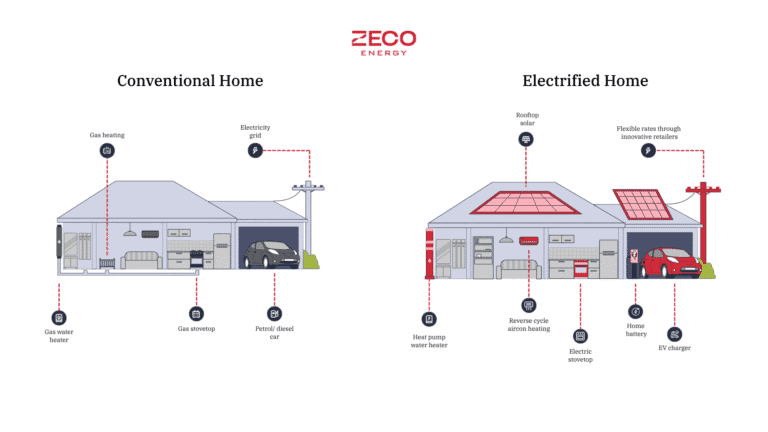
For households in Newcastle and across NSW, a new state scheme has made home electrification, including solar and batteries, more accessible. The NSW Government’s Home Energy Saver program offers eligible households (taxable household income of $210,000 or less who also own their property) zero-interest loans of up to $15,000 over 10 years, plus discounts of up to $4,000 for lower-income households and eligible concession card holders.
We applaud the New South Wales Government, in particular because the scheme is not limited to one product. It can support a full electrification path across solar, batteries, switchboards and home efficiency measures, which means more households can look at the full picture rather than one isolated upgrade.
What is the NSW Home Energy Saver program?
The Home Energy Saver program is designed to reduce the upfront cost of energy-saving home upgrades. The loan stream is open now, while the discount stream is listed by the NSW Government as coming soon.
For clients who qualify for both forms of support, the recommended pathway is to apply for the discount first, then use the zero-interest loan to cover the remaining cost.
What can the scheme be used for?
The scheme covers rooftop solar, residential batteries and switchboard upgrades. It also applies to a range of electrification products including heat pump water heaters, solar water heaters, reverse-cycle air conditioning, induction cooktops, EV level 2 chargers and DC ceiling fans.
Can it be combined with the federal battery rebate?
Yes. The NSW scheme can be used alongside the federal home battery support, which the NSW Government says can reduce the cost of an installed battery by around 30%. That makes the state scheme more useful for households looking to combine battery storage with a broader electrification upgrade.
What numbers are worth quoting?
A typical (we use that word around very lightly) solar-plus-battery system can cost between $15,000 and $40,000 depending on system size and how electrified the home is. With a general payback period being about seven years and that figure now set to drop further, we believe electrification in NSW is now as attractive as it has ever been.
For broader context, it's understood more than half of NSW homes already have solar and this program will still apply to them in other facets.
How big is the program?
The NSW Government says the package includes $480 million in zero-interest loans, expected to benefit more than 32,000 households, plus $77 million for targeted upfront discounts.
Why this matters
For NSW households, this shifts the conversation from whether upgrades are possible to how they should be staged. Solar, batteries, switchboard work and electrification can now be approached as part of one practical plan rather than a sequence of disconnected purchases. That is especially relevant for households trying to reduce bills without carrying the full upfront cost at once.
What can ZECO Energy help with?
On the residential side, ZECO Energy can help homeowners plan and deliver full electrification including solar, batteries, switchboard upgrades and broader electrification works such as hot water, reverse-cycle air conditioning, EV charging and induction cooking. That fits well with the NSW scheme and we're excited to continue making renewable energy accessible to more people in NSW.
Furthermore, ZECO can help across more complex multi-dwelling properties and we are seeking advice on how this scheme applies to them. That includes Solar Sharing architecture for apartment and strata environments, where solar needs to be shared fairly across multiple residents while still meeting billing, metering and DNSP compliance requirements. Clients view our Multi-Dwelling Unit Solar offering as an end-to-end capability covering design, installation, monitoring, billing where applicable, and maintenance.
The key takeaway
If you live in NSW, we believe this strengthens the case - both in credibility and financials - for home electrification. And because the program applies to more than just solar panels, it gives households a broader way to improve comfort, cut bills and move further off gas over time.

