
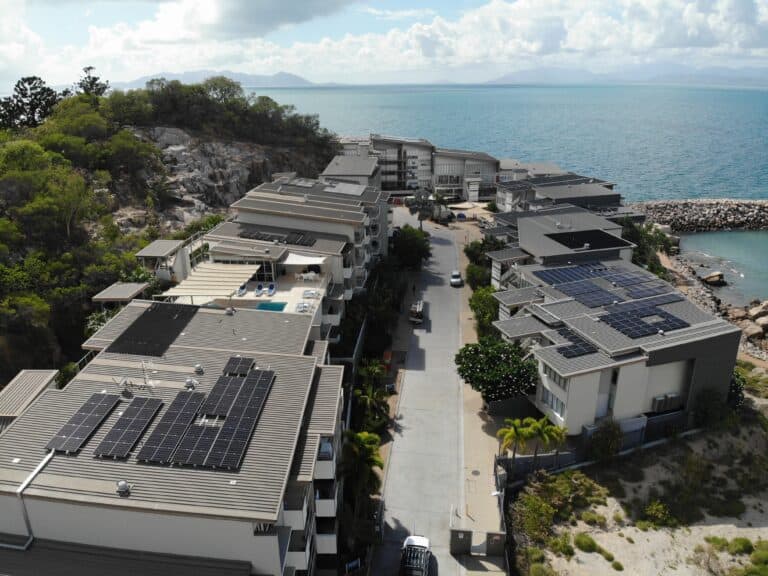
What was previously one of Australia’s biggest solar inequities - people living in apartments – is starting to show signs of change.
The Australian Government’s Community Solar Banks program is investing in shared solar for apartment residents, among other target markets. Victoria’s Solar for Apartments program offers rebates of up to $2,800 per apartment and $140,000 per property. NSW offers eligible strata schemes up to $150,000 towards shared solar, with higher support available in selected disadvantaged areas. Other states are coming to the party soon.
While it’s worth acknowledging the technical difficulties that continue to persist in delivering these solutions, the industry (and everyday Australians) are excited to welcome the progress. But it exposes another group facing remarkably similar barriers. One that has so far been left behind by the policy makers.
What about people living in lifestyle communities?
Residential land-lease communities – generally referred to as lifestyle communities - are home to around 130,000 Australians. Residents typically own their dwelling while leasing the land beneath it, with the sector particularly popular among older Australians and downsizers. They’re set to become infinitely more popular over the coming decades given Australia’s ageing population.
While these look communities can look the same as a residential street, electrically speaking, they operate very differently. These retirement-style communities operate through embedded electricity networks. Rather than every home behaving as an entirely independent connection to the distribution network, dozens or hundreds of dwellings can sit behind a common site connection. The Australian Energy Regulator (AER) specifically recognises residential land-lease communities as a type of embedded network, essentially a private network within a single site where the owner buys power from the grid at the meter level and sells it to the people inside. These sites were never designed to accommodate solar, and that has become clear over recent years. Installing panels independently on home after home does not necessarily mean the electricity network sees dozens of independent systems, as it would request to in a general suburban street Export (excess solar) requirements can apply to the aggregate generation at the site connection. Once enough solar is installed, the community needs a way of knowing what the entire site is doing and controlling its generation accordingly. Often, this means no more solar on site. But this is where technology is beginning to change what is possible.
In response to the industry feedback of ‘our residents want solar but we can’t install any more, ZECO Energy's Marshall technology has now been adapted for this specific problem, with site-level monitoring and export control across multiple distributed systems. ZECO has already used the same underlying approach on complex multi-residential projects: individual residents can have solar while Marshall coordinates those systems against a site-wide network requirement. The broader Marshall architecture is designed around multi-inverter control, centralised monitoring and DNSP compliance rather than treating every inverter as an isolated asset.
We’re overjoyed to announce that ZECO is now in the early stages of applying this architecture across multiple lifestyle-community projects, creating a pathway for more communities to come on board.
The policy gap, however, remains.
We’re overjoyed to announce that ZECO is now in the early stages of applying this architecture across multiple lifestyle-community projects, creating a pathway for more communities to come on board.
Victoria's Solar for Apartments program requires an eligible Owners Corporation and explicitly excludes retirement villages and properties connected to embedded networks. NSW's program is similarly restricted to qualifying strata schemes. ACT support is built around unit-title apartment complexes.
Those rules make sense for programs designed around apartment buildings. But they also mean that a growing housing sector containing roughly 130,000 Australians can fall outside the very programs created to solve shared-solar access.
With nearly 40 per cent of Australian households already boasting rooftop solar, there is now the opportunity to connect another 40,000 plus households (on those ratios) to the fastest growing renewable energy source, without factoring in the expected growth.
Australia has already accepted the principle that the type of home you live in should not determine whether you can benefit from rooftop solar.
The next question is whether that principle should stop at the apartment building gate.

