
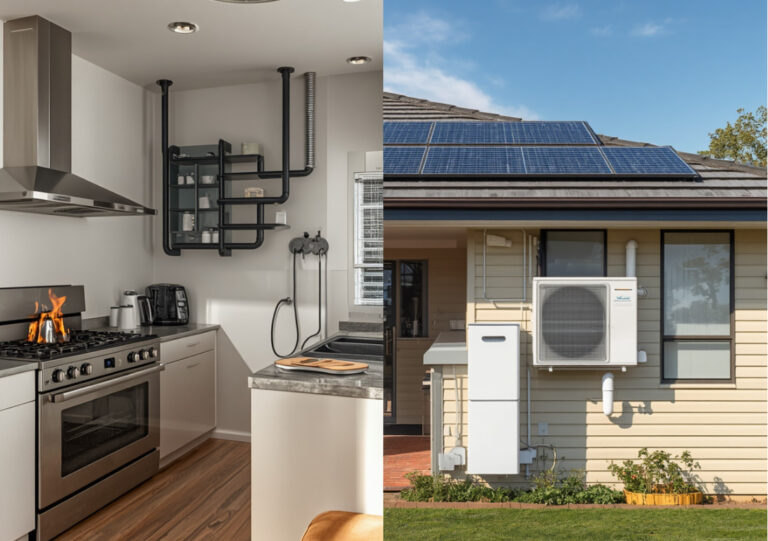
Gas costs in Australia have increased dramatically over the last decade, and they will continue to increase. However, the efficiency of electric alternatives, such as heat pumps, induction cooking, and heat pump hot water, has increased enormously. As a result, for the majority of Australian households, the financial case for moving from gas to electric appliances is now clear. This page will explain the running costs comparison for each category, using actual data available on efficiencies and savings for households. It will also explain how, by pairing electric appliances with solar and battery systems, the financial case is even stronger.
KEY FIGURES AT A GLANCE
Heating: Reverse cycle air conditioning units are up to 300% more efficient than Gas Heating
Cooking: Induction Cooking uses ~40% less energy than Gas Stoves
Hot Water: Heat pump hot water systems use up to 75% less electricity than electric storage heaters
Combined savings: $800 - $2,400 per year by switching from Gas to Electric for all three areas.
Reverse cycle air conditioning, or a heat pump, can be as much as 300% more efficient than using gas heating. This means that a heat pump uses one unit of electrical energy and produces three or more units of heating or cooling energy. This is because a heat pump does not produce energy but simply uses the energy it requires to "move" the available energy from the outdoor air and transfer it inside, even on cold days.
Gas ducted heating requires fuel to be burned to produce hot air, and its efficiency is typically between 85 and 95%. Again, this is a fraction of what a heat pump can produce per unit of energy.
Typical annual savings by converting to a heat pump from a gas ducted heating system: $500 - $1,500 per year
Another advantage of a reverse cycle air conditioning system is its ability to provide both heating and cooling, thus eliminating the need to purchase a separate cooling unit.
Induction cooktops are said to be 40% more efficient than conventional gas stoves. Induction cooking does not heat the air surrounding the cooking vessel, as gas stoves do, but rather heats the vessel directly through the use of electromagnetic fields.
Besides the efficiency of the cooktop, induction cooking also offers the advantage of no gas combustion, thereby improving the quality of the air in the house by eliminating the emission of NOx, CO, and HCHO gases, which are present in the emission of gas stoves.
Heat pump hot water systems use up to 75% less electricity than traditional electric storage hot water systems and perform better on operating costs compared to gas hot water systems. Cost savings of switching to a heat pump hot water system from a gas hot water system: $300 - $900 per year
Heat pump hot water systems operate by extracting heat from the air, rather than using a fuel source or heating elements. Heat pump hot water systems are best suited to warmer climates but are cost-effective at any time of the year.
The economics of electrification are even stronger if combined with solar and battery. By combining electric appliances with solar and battery, you are able to use your own generated electricity rather than purchasing electricity from the grid. A complete electrification package (solar, battery, heat pump, hot water, induction) will pay for itself in 6 to 8 years in most cases.
The key multiplier: every appliance that uses solar self-consumption rather than grid electricity has the marginal cost of operation at near zero during solar hours.
Currently, the Victorian Government has announced a ban on gas connections for new homes from 1 January 2024. Incentives are also offered for the transition from gas. We at ZECO can assist you in determining your eligibility for the rebates offered currently and provide the best option for a cost-effective change.
When it comes to heating, cooking, and hot water systems, electric appliances such as heat pumps, induction stovetops, and heat pump hot water systems are now more cost-effective compared to gas appliances. This is mainly attributed to the fact that gas prices are increasing while the efficiency of electric appliances is high.
The cost may vary depending on the number of appliances you want to switch from gas to electric. A full electrification installation may cost between $10,000 and $25,000 before rebates. When we add solar and a battery to the system, the cost may rise to between $20,000 and $40,000. However, the cost may pay for itself within 6 to 8 years.
Upgrading the switchboard may not be necessary as the Marshall Blackbox from ZECO can efficiently manage the electrical load without the need for a switchboard upgrade. This may save you thousands of dollars compared to a switchboard upgrade.
Induction cooking is quicker, more energy-efficient, and offers better indoor air quality than gas cooking. Newer induction cooktops are also more hygienic to clean and offer more precise temperature control. The only change is the use of induction-compatible cookware (which the majority of modern pots and pans are).



We're always working to understand how we can better serve our clients.