
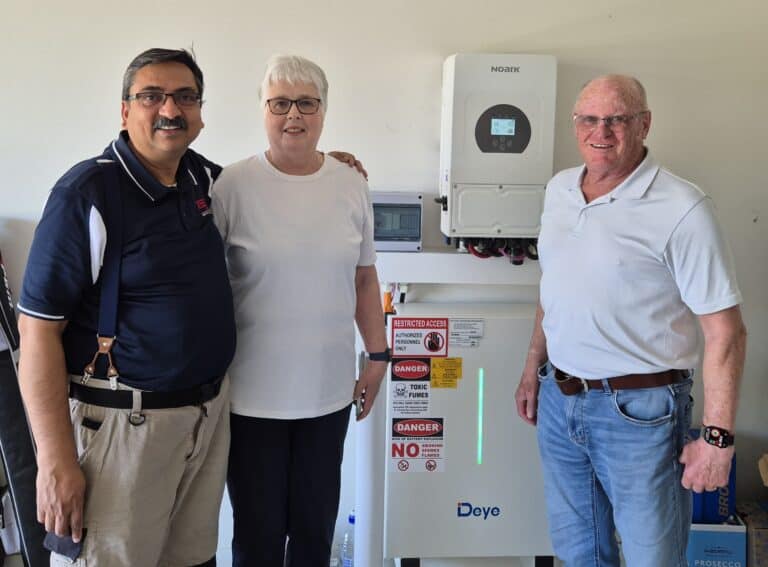
When Felicity began looking to expand her home’s battery capacity, she was repeatedly told it wasn’t possible. Her existing Qcells AC-coupled system couldn’t be extended, Qcells had left the Australian market and most installers were clear that adding a second AC-coupled system would create operational conflicts. After her original battery and inverter failed and were replaced under warranty, the sense of being stuck only grew stronger.
Once ZECO Energy repaired the system, our engineers started exploring whether there was a way forward rather than a dead end. The main challenge was straightforward but complex: two AC-coupled battery systems on one site typically work against each other. One system can discharge to support the home while the other charges from the grid, creating inefficiencies and instability. It’s the reason most people in the industry avoid this setup altogether.
Over several weeks, our engineers developed a configuration using Marshall technology to integrate a new Noark/Deye AC-coupled BESS alongside the existing Qcells unit. Marshall’s role was to coordinate both systems, reading site load, grid power, PV production and battery behaviour, then ensuring they operated in sequence rather than conflict.
The Qcells system remained first priority, with the Noark system managed as second priority. This allowed the site to function as one coherent system without either battery undermining the other’s operation.
The result is a stable, expanded setup that gives Felicity the additional storage she needed. Her Qcells unit now works seamlessly with the Noark system, providing a combined capacity that actually suits the household’s usage. As she described it, “It’s all working as the one system… so the system is absolutely sized perfectly.” She also noted the effort behind the solution: “He’s extraordinary… He’s been so helpful for us and we can’t thank ZECO Energy enough.”
Project Felicity shows what can happen when a difficult technical constraint is approached with patience and some creative engineering. It’s a natural innovation and evolution of the industry, finding a methodical, workable pathway where most installers assumed none existed.
For technical enquiries or installation support, contact
marshall@zeco.au or support@datamarshall.com.au
ZECO Marshall is a dynamic export control and energy management product that optimises solar energy usage. It allows flexible energy exports, supports load control, and integrates with solar inverters, energy meters, and smart devices through our unique hardware and software solution.
ZECO Marshall is used for:
ZECO offers three main Marshall products:
Marshall Lite – A compact, essential-feature version for dynamic export control.
Marshall Blackbox – Comprehensive control and monitoring capabilities, includes a single-phase meter.
Marshall Blackbox Ultra – Includes an integrated three-phase meter for detailed energy insights.
ZECO Marshall supports most major inverter brands and is compatible with SAPN, ENERGYQ, and Victorian DNSPs (AusNet, United Energy, Jemena, Powercor, Citipower).
Overload Control prevents household and commercial overload by monitoring energy import amperage. If the current exceeds the main switch rating, ZECO Marshall trips non-essential loads to keep the system within safe limits. This feature is particularly useful for preventing residential system trips.
ZECO Marshall devices are designed for easy installation. Refer to the installation manuals for more details. They can be connected via LAN, Wi-Fi, or RS485, depending on the setup. A licensed installer should handle the installation to ensure proper integration and compliance.
While an internet connection is recommended for real-time monitoring and firmware updates, ZECO Marshall can operate in a local network environment with limited cloud dependency.
Yes, ZECO Marshall devices are Clean Energy Council (CEC) certified, Australian Made and comply with relevant Australian energy regulations for export control and metering.
Users can monitor and control Marshall devices through our web portal or mobile app, allowing access to energy data, export settings, and load control features remotely.
Yes, Marshall supports both residential and commercial solar installations, making it ideal for larger energy management applications.
For support, you can contact ZECO Energy’s customer service team via phone, email, or the official support portal located at the top of this page. Firmware updates and troubleshooting guides are also available at the bottom of this page.
Email: support@zeco.au
Phone: 03 4422 4455

